Halloween, often referred to as Halloween Day, is a holiday observed on October 31st each year. It is primarily celebrated in the United States, Canada, and various other countries, although the extent and customs of celebration can vary. Halloween has Celtic origins and was influenced by Christian traditions. It is known for its association with various traditions and activities. Have you ever wondered why we celebrate Halloween?
It is often believed that on Halloween, the boundary between the living and the spirit world is at its thinnest. The origins of Halloween stretch back more than 2,000 years to the ancient Celtic festival known as Samhain. This belief harks back to the Celtic festival of Samhain, where it was thought that spirits could more easily cross over into the realm of the living.
Who are Celts?
The Celts were an Indo-European ethnic and cultural group that originated in Central Europe and later spread to various parts of Europe, including the British Isles, Ireland, Scotland, Wales, Brittany (in France), and parts of Spain.
Samhain was among the four significant festivals observed by the ancient Celts, signifying the conclusion of the harvest season and the advent of winter. This festivity occurred on the night of October 31st and carried over into November 1st. This festival had deep spiritual and agricultural significance. One of the central beliefs associated with Samhain was that on this night, Thinning of the Veil takes place which is the boundary between the living and the spirit world believed to be at its thinnest. It was thought that the spirits of the deceased, as well as other supernatural entities, could more easily interact with the living during Samhain.
During Samhain, the Celts engaged in various rituals and customs, including lighting bonfires to ward off evil spirits, making offerings of food and drink to appease the spirits, and dressing in costumes and masks to disguise themselves from spirits. As Christianity gained influence in the Celtic regions, Samhain gradually evolved into Christian holidays. November 1st became All Saints’ Day (All Hallows’ Day), and November 2nd was dedicated to All Souls’ Day. The evening before All Saints’ Day, known as October 31st, acquired the name All Hallows’ Eve, which was later abbreviated to Halloween.
Traditions on Halloween day
Dressing up in costumes, masks, and disguises on Halloween is believed to have originated from the ancient practice of wearing masks to confuse and ward off spirits. Today, costumes are seen as a fun way to celebrate the holiday.
The custom of door-to-door trick-or-treating on Halloween has a centuries-old history. In medieval Europe, it was known as “souling,” where people would offer prayers for the dead in exchange for food.
The practice of carving pumpkins into Jack-o’-Lanterns has its origins in Ireland. Initially, individuals carved turnips and potatoes, but when Irish immigrants arrived in America, they began using pumpkins due to their greater availability.
Halloween Book
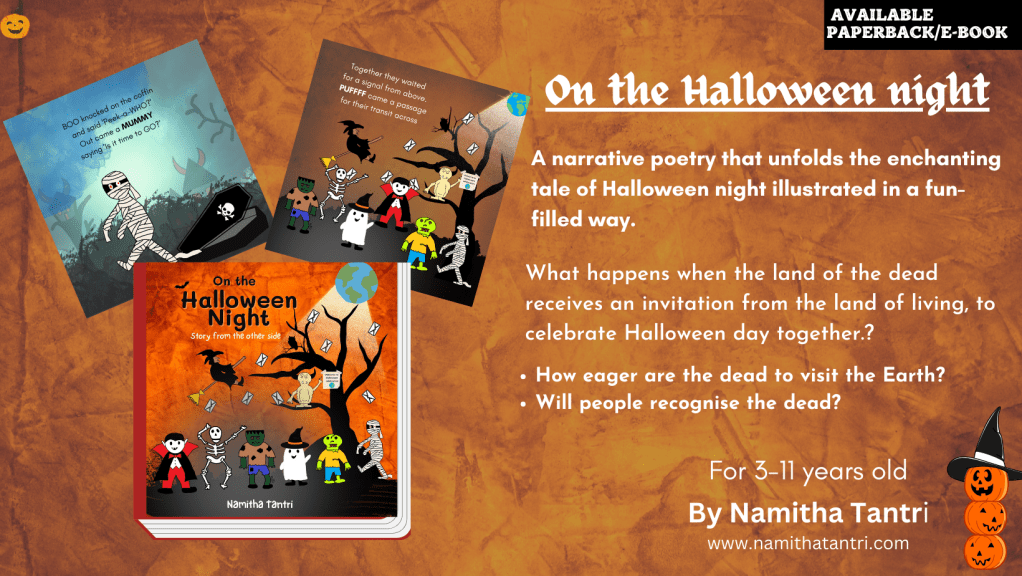
Read a fulfilled fable On the Halloween night available in paperback and ebook format:
- A narrative poetry on what happens on Halloween night
- Learn the different characters of Halloween.
- For all Halloween fans, aged 3-11 years.

 Namitha tantri
You must be logged in to post a comment.